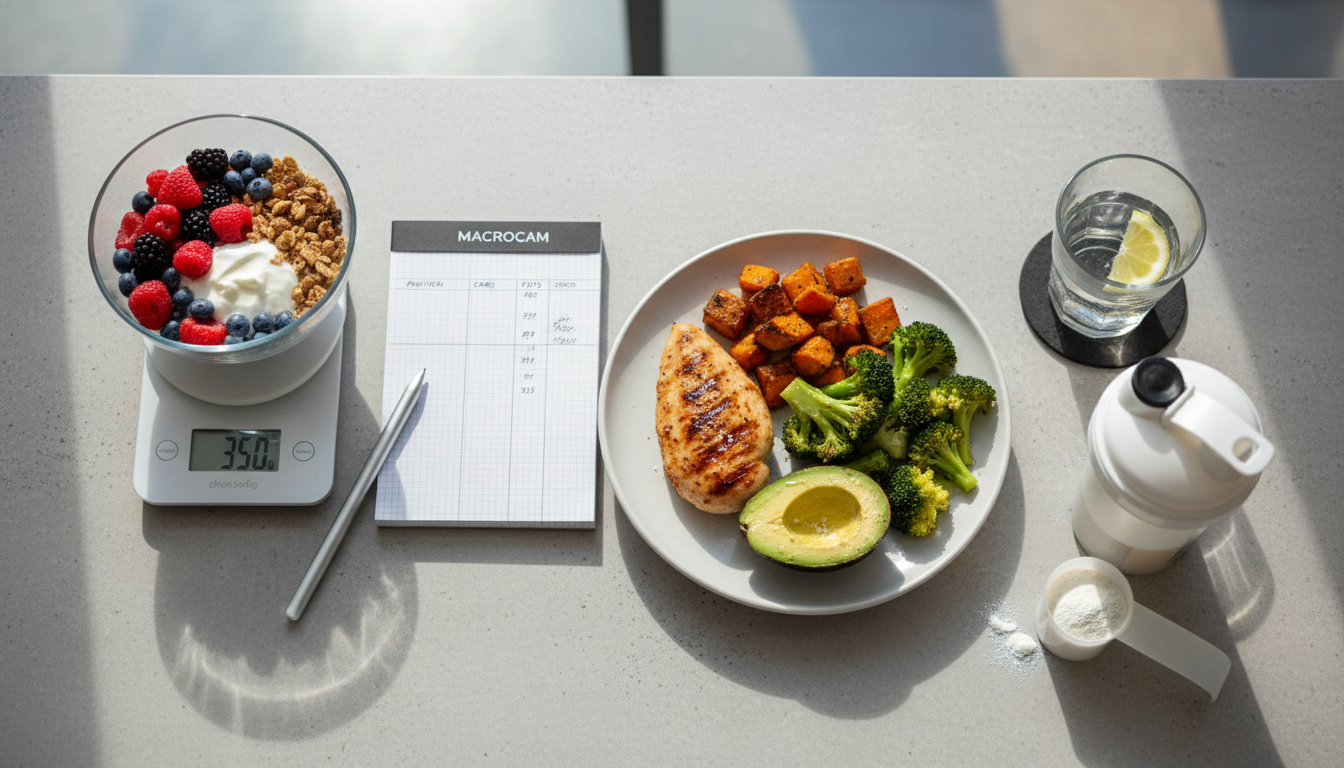
Macro Tracking For Weight Loss: What Actually Works?
Macro tracking for weight loss is the most effective method for sustainable fat loss. It works by creating a precise calorie deficit while strategically managing your protein, carbs, and fat. This approach protects muscle, manages hunger, and fuels your body correctly. We believe this precision turns weight loss from a struggle into a predictable science.
Table of Contents
- What Are Macros and Why Do They Matter?
- How Macro Tracking Creates a Weight Loss Advantage
- Setting Your Personal Macro Targets
- A Practical Week of Macro Tracking
- Common Macro Tracking Mistakes to Avoid
- Evidence and Numbers
- Tools and Apps to Simplify the Process
- FAQ
What Are Macros and Why Do They Matter?
Macronutrients, or “macros,” are the three primary nutrients your body needs in large amounts. They are protein, carbohydrates, and fats. Each macro provides energy and serves unique, critical functions. Understanding them is the foundation of effective nutrition.
- Protein is the building block of your body. It repairs tissues, builds muscle, and creates enzymes. Protein also promotes satiety, keeping you fuller longer than other macros.
- Carbohydrates are your body’s preferred energy source. They fuel your brain, nervous system, and physical activity. Carbs are not the enemy; the type and amount matter most.
- Fats are essential for hormone production, vitamin absorption, and cell structure. Healthy fats support metabolism and help regulate inflammation.
Simply eating less of everything is a flawed strategy. It often leads to muscle loss, metabolic slowdown, and intense hunger. Tracking macros ensures your calorie deficit is nutritionally intelligent. We focus on protein first to safeguard your metabolic engine during weight loss.
How Macro Tracking Creates a Weight Loss Advantage
Calorie counting answers one question: “How much?” Macro tracking answers the more important question: “What is this food doing for my body?” This shift in focus provides a massive advantage.
You could eat 1,800 calories from pizza and soda. You could also eat 1,800 calories from chicken, rice, vegetables, and avocado. The scale might move similarly at first, but the body composition results will differ drastically. Your hormones, energy, and muscle mass respond directly to your macro intake.
Strategic macro management directly supports weight loss by:
- Preserving Muscle Mass. Adequate protein signals your body to burn fat, not muscle. Muscle is metabolically active tissue; keeping it maintains your calorie-burning potential.
- Stabilizing Energy and Mood. Balanced carb intake prevents blood sugar crashes. This avoids the fatigue and irritability that derail diets.
- Controlling Appetite Naturally. Protein and fiber from smart carb choices increase feelings of fullness. This reduces cravings and makes your deficit easier to maintain.
- Optimizing Metabolic Health. The right fats support thyroid and sex hormones. These hormones are crucial for a healthy, responsive metabolism.
Our framework transforms eating from a vague hope into a targeted strategy. You learn how your body uniquely responds to different foods.
Setting Your Personal Macro Targets
Generic macro plans fail because they ignore your individuality. Your perfect numbers depend on your weight, body fat, activity, age, and goals. A calculated plan is your roadmap to success. Follow this detailed process to set yours.
Step 1: Find Your Calorie Target. First, calculate your Total Daily Energy Expenditure (TDEE). This is the calories you burn in a day. Use a reputable online TDEE calculator. Input your age, sex, height, weight, and activity level honestly. For weight loss, subtract 300-500 calories from your TDEE. This creates a moderate, sustainable deficit.
Step 2: Determine Your Protein Baseline. Protein is your anchor macro. Calculate it based on your body weight, not a percentage of calories. A strong starting point is 0.8-1.2 grams of protein per pound of your target body weight. If your goal weight is 150 lbs, aim for 120-180 grams of protein daily. This range supports muscle retention.
Step 3: Set Your Fat Floor. Dietary fat is essential for health. Set a minimum “floor” to ensure proper hormonal function. A good rule is 0.3-0.4 grams of fat per pound of body weight. For a 180-pound person, this means at least 54-72 grams of fat daily.
Step 4: Fill the Remaining Calories with Carbs. Now, allocate your remaining calories to carbohydrates. Calculate your calories from protein (grams x 4) and fat (grams x 4). Subtract this sum from your total daily calorie target. Divide the remaining number by 4 to get your carb grams. This approach prioritizes protein and health fats first.
Example Plan for a 180-lb Person (2000 Calorie Target):
- Protein: 180g (720 calories). Based on 1g per lb of goal weight.
- Fat: 65g (585 calories). A moderate, healthy intake.
- Carbohydrates: 174g (695 calories). Fills remaining calories for energy.
We recommend using an app like Macrocam to perform these calculations instantly. It adjusts them as you lose weight, keeping your plan dynamic.
A Practical Week of Macro Tracking
Knowledge without action is useless. Here is a detailed blueprint for your first successful week. This plan builds habits progressively.
Days 1-2: The Foundation Phase. This phase is about setup, not restriction. Your only job is to prepare.
- Calculate your personal macro targets using the method above.
- Download your chosen tracking app. Create your profile and input your targets.
- Conduct a kitchen audit. Stock up on staples: lean proteins, complex carbs, healthy fats, and fibrous vegetables.
- Practice logging a few common meals you eat. Get familiar with the app’s search and barcode scanner.
Days 3-5: The Consistent Logging Phase. Now, track everything you consume with precision. Accuracy is key.
- Log every meal, snack, beverage, and cooking oil before you eat it. This allows for adjustments.
- Use a digital kitchen scale. Weighing food is non-negotiable for accuracy, especially for proteins, grains, and fats.
- Plan one meal ahead. Knowing what you’ll eat for lunch prevents poor decisions when hungry.
- Each evening, review your macro pie chart. Did you hit protein? Were carbs or fat too high? Note patterns without judgment.
Days 6-7: The Review and Iterate Phase. Reflection turns practice into lasting strategy.
- Check your weekly averages in the app. Look at your consistency, not just daily totals.
- Perform a personal audit. How was your energy? Hunger? Sleep? Digestion? Your body gives feedback.
- Tweak one thing for next week. Maybe you need a pre-workout carb snack. Or perhaps you need to prep more protein-rich lunches.
- Celebrate the habit. You tracked for a week! That’s the real victory.
We see our most successful members treat tracking as a daily habit, like brushing their teeth. Perfection is not the goal; consistent data collection is.
Common Macro Tracking Mistakes to Avoid
Even with the best intentions, common pitfalls can slow progress. Avoid these seven mistakes to accelerate your results.
- Eyeballing Portions. Guessing “a cup of rice” or “a palm-sized chicken breast” is highly inaccurate. Deviations of 20-30% are common. This error makes your data useless. Always use a scale for solid foods for at least the first month.
- Neglecting Protein Early in the Day. Hitting your daily protein target is crucial, but timing helps. Front-loading protein at breakfast and lunch boosts satiety throughout the day. Don’t save 100 grams of protein for dinner.
- Forgetting Liquid Calories and Condiments. Coffee creamer, cooking sprays, dressings, and sauces contain significant macros. A tablespoon of oil is 120 calories of pure fat. Log every ingredient that enters your food.
- Being Too Restrictive with Food Choices. This is not an “eat clean” mandate. If a cookie fits your macros, you can eat it. Demonizing foods leads to bingeing. The flexibility of macro tracking is its greatest strength. We encourage fitting in foods you love.
- Not Adjusting Your Targets as You Lose Weight. A plan for 180 lbs is wrong for 170 lbs. Your metabolism changes. Recalculate your TDEE and macros every 8-10 pounds of weight loss to stay in an effective deficit.
- Quitting After a “Bad” Day or Meal. One high-carb meal doesn’t ruin your week. It’s a data point. The worst thing you can do is stop tracking because you went over. Log it honestly and resume your plan at the next meal. Consistency over time wins.
- Prioritizing Macros Over Food Quality. Hitting your macros with processed foods is possible, but not optimal. Your health depends on vitamins, minerals, and fiber. Aim to hit 80% of your targets with whole, nutrient-dense foods.
We designed Macrocam’s barcode scanner and quick-add features specifically to combat mistakes #1 and #3. It makes accuracy effortless.
Evidence and Numbers
Macro tracking is not a trend; it’s applied nutritional science. These studies quantify its advantages for weight loss and body composition.
- A 2021 meta-analysis found that higher protein diets (1.6g/kg) led to 16% greater fat loss and significantly better muscle retention compared to standard protein diets during calorie restriction. This directly supports the macro tracking emphasis on protein prioritization. Source
- Research on dietary adherence shows that individuals who track their food intake lose up to twice as much weight as those who do not track. The simple act of monitoring creates awareness and accountability that drives behavior change. Source
- Data on metabolic adaptation reveals that for every pound of muscle lost during weight loss, your resting metabolism decreases by approximately 5-10 calories per day. Preserving muscle through adequate protein and strength training is critical for long-term metabolic health. Source
Tools and Apps to Simplify the Process
Manual tracking with pen and paper is a recipe for burnout. The right tool removes friction and guarantees accuracy. Here’s a detailed comparison to help you choose.
| Method | Pros | Cons | Best For |
|---|---|---|---|
| Pen & Paper / Notes App | No learning curve. Deeply personal. | Prone to massive calculation errors. No database. Impossible to analyze trends over time. | Someone wanting to test their commitment before using an app. |
| Spreadsheet (Excel/Sheets) | Total customization. Free. Can create complex formulas. | Extremely time-consuming data entry. Requires building your own food database. No convenience features. | Data scientists or nutrition coaches who need highly specific, proprietary calculations. |
| General Health App (e.g., MyFitnessPal) | Large food database. Tracks calories and basic macros. | Database contains many user-submitted errors. Free version lacks essential features like macro scanning. Focus is on calories, not macro strategy. | Casual calorie counters who don’t need high precision. |
| Dedicated Macro App (Like Macrocam) | Precision-focused. Fast barcode scanning with verified data. Custom macro targets by gram. Clean interface for macro ratios, not just calories. Progress charts tied to macro adherence. | Often requires a subscription for full features. | Anyone serious about body composition goals who values accuracy, speed, and a strategic interface. We built Macrocam to be the last app you’ll ever need for this purpose. |
The evolution is clear: dedicated tools save time and improve accuracy. A good app turns tracking from a chore into a quick, daily check-in.
FAQ
Is macro tracking better than calorie counting? Yes, for achieving a better body composition. Calorie counting only manages energy balance. Macro tracking manages energy balance and nutrient partitioning. It ensures the weight you lose comes primarily from fat, not muscle. This leads to a leaner, stronger result.
How long does it take to see results from macro tracking? Physiological changes like stabilized energy and reduced cravings often start within the first week. Visible changes in the mirror or how your clothes fit typically begin after 2-4 weeks of consistent adherence to your calculated targets. The scale may fluctuate daily; trust the weekly average trend.
Do I have to track macros forever? Absolutely not. Most people track diligently for 3-6 months to reach their goal and internalize portion awareness. After that, many switch to a “maintenance tracking” mode a few days a week, or use the habits they’ve learned to eat intuitively. The education lasts a lifetime.
What if I eat at a restaurant or can’t weigh my food? Don’t avoid social events. Use the app’s restaurant logging features or search for generic entries (e.g., “grilled chicken breast restaurant”). Use visual estimates (your hand is a good guide) and log it as accurately as possible. One estimated meal won’t ruin your week. Consistency over time is what matters.
Can I build muscle while tracking macros for weight loss? Yes, it’s possible for beginners or those returning to training—a state called “body recomposition.” The key is a very modest calorie deficit (200-300 calories), very high protein intake (1.2g+ per lb of body weight), and a consistent strength training program. Your macros will prioritize protein and fuel your workouts with carbs.
Ready to stop guessing and start knowing? The most effective path to sustainable weight loss is through precision. Download Macrocam today and let our technology handle the complex math. You focus on building the habits. We provide the flawless system to support your transformation. Your data-driven journey starts now.